Proving manhood through violence
West Side StoryProving manhood through violence is a code that makes aggression appear to be evidence of courage, authority, and belonging. In West Side Story, it shapes the conduct of the Jets and the Sharks, but it also exposes the cost of treating violence as the test of whether a young man is worthy of respect: the boys gain standing by risking lives, while the surviving characters recognize how little future that standard leaves them.
What the code demands
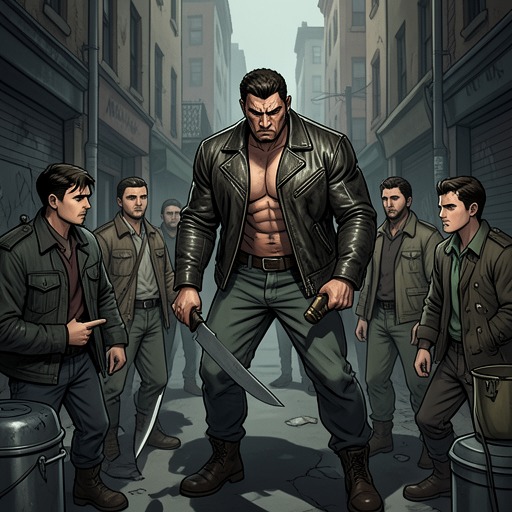
For the young men who live by it, masculinity must be demonstrated rather than simply claimed. A boy is expected to show he will not back down when a fight becomes serious, and the group's regard depends on meeting that expectation. Action doubts that Baby-John has the nerve to be the kind of recruit the Jets need, despite the fact that Tony Wyzek had argued for letting a younger boy join. The distinction, in Action's mind, is between a boy who can belong and one who can be relied on when fighting turns dangerous.
The standard also narrows the choices available to a gang leader. Action considers challenging Riff Lorton for command, but recognizes that taking power would mean actually directing the Jets and bearing responsibility for their decisions. Remaining in a position to criticize Riff lets him pressure the leader to prove himself. Riff's authority is therefore bound to continual performance: he must keep the group active and demonstrate that he can lead. The gang's cohesion and reputation among other neighborhood groups are presented alongside that contest for status, linking leadership to the capacity to command and confront.
Violence as group practice
The code is not confined to the duel. Riff considers ways to occupy the Jets while they wait for night, including robbing people and seeking vulnerable targets to attack. The episode presents these possibilities as part of the group's ordinary repertoire of activity, even as Riff rejects them for practical reasons: the park is crowded with police, and the targets he considers may pose risks or bring unwanted attention. His decision is not a rejection of violence as a measure of masculine worth; it is a calculation about when and against whom the Jets can act.
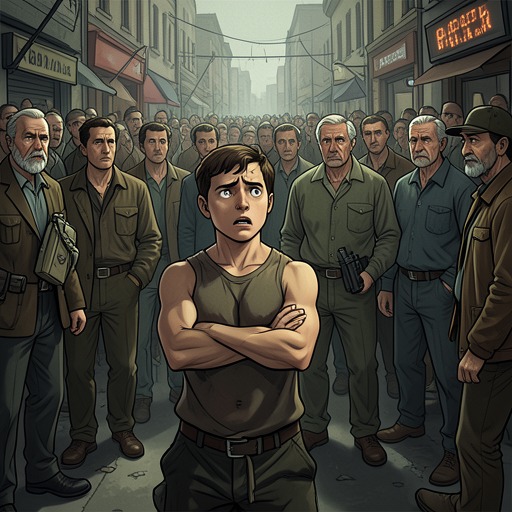
The same logic governs Riff's treatment of Anybodys. When Anybodys insists on being tested, Riff announces that the Jets will go looking for girls and pointedly includes her in the challenge. The group laughs at her, and she leaves in frustration after Riff blocks her attempted strike and Baby-John joins in the mockery. The episode makes belonging conditional on a masculine code that Anybodys is not allowed to define for herself: the Jets turn her challenge into a spectacle and use ridicule to police the boundary of the group.
Gender and control
The novel also connects masculine authority to control over women. Riff speaks of seeking girls as something the Jets can do together, treating the prospect as part of their collective night's entertainment. In a separate encounter, Bernardo reaches toward Anita Palacio in a teasing, familiar manner; Anita objects to the assumption that coming to America with open hearts means being sexually available. She then strikes Pepe after he dismisses her protest. Her response draws a clear distinction between welcoming a new life and surrendering control over her own body.
These moments differ in circumstance, but together they show that the code extends beyond fighting other boys. It licenses men to treat women as proof of their own standing or as people whose boundaries can be tested, while women's resistance can interrupt that claim. The episodes do not make the women passive symbols: Anybodys acts on her anger and Anita directly rebukes the men. Yet the group response to Anybodys, and the assumptions Anita has to confront, reveal how force and ridicule help preserve male authority.
The duel and its aftermath
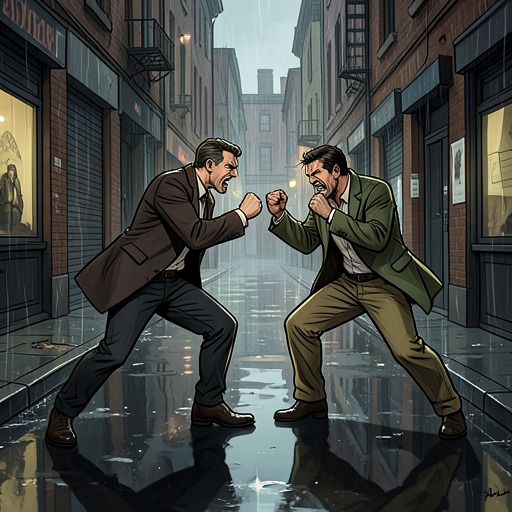
The code becomes especially destructive when Bernardo humiliates Tony in front of the Sharks. Riff watches Tony endure the taunts and slaps and feels shame on his friend's behalf. Remembering the times he defended Tony from criticism within the Jets, Riff now interprets Tony's restraint as a failure of masculine pride. He reaches for the knife at his hip. The gesture shows how quickly an insult can become a demand for violent proof: rather than accept Tony's different response, Riff understands the scene through the expectation that a man must answer humiliation with force.
After Riff and Bernardo die, Baby-John's understanding of toughness turns into a calculation about mortality. He is fourteen; in his estimate, the two dead gang leaders were about eighteen. If becoming a tough man means following their path, he reasons, he may have only four or five years before he too is dead, perhaps after spending some of that time in a correctional institution. He admires Riff and recognizes Bernardo's courage even though he hated him, but admiration does not make their fate desirable. The boy's imagined appeal for rescue frames the future offered by the code as something to escape, not simply a badge to earn.
Maria's judgment of the cycle
Maria Nunez gives the aftermath its clearest moral interpretation. When Tony explains that Riff was brave, afraid of no one, and always seeking a fight to prove it, she compares him with Bernardo. She sees the two as alike in their restless hostility and in their need to demonstrate manhood. Her judgment does not erase the affection Tony feels for Riff or her own grief for Bernardo; instead, it allows pity for both young men to coexist with condemnation of the violence that shaped their lives.
Maria argues that the boys had already experienced extraordinary amounts of joy and violence in their youth, yet destroyed what they touched while claiming that their only hatred was for one another. She imagines no meaningful future for them: they would continue to be hunted by people who could gain from their violence, and growing older would not necessarily make them wiser. Her conclusion is severe but specific to the cycle she has witnessed: Riff and Bernardo's deaths end lives organized around mutual pursuit, while Tony, who has wanted to change, must not be drawn back into the same fate. Through Baby-John's fear and Maria's judgment, proving manhood through violence appears not as lasting strength but as a social test that reproduces danger and makes early death seem like its expected price.